

It’s coming close to 1.5 years that I’ve been in a CPO role.
The mindshift that has happened over the year is incredible.
From a relatively small team of 10ish people, my responsibility was elevated to a ~150 person team.
I had to start thinking differently.
If you still tinker with execution and allow yourself to get too involved, you’ll burn out.
If you try and play a therapist for your entire team, you’ll drown.
You need to build systems - systems that can scale.
You have to start thinking about leverage. Otherwise, the org will get stuck.
The people will lose morale; the efficiency will drop.
Another curious thing is that your imposter syndrome is amplified.
Who is a CPO? Some might say he’s a deputy CEO from the product side.
But should CPO really step on CEO’s toes? I’d say no.
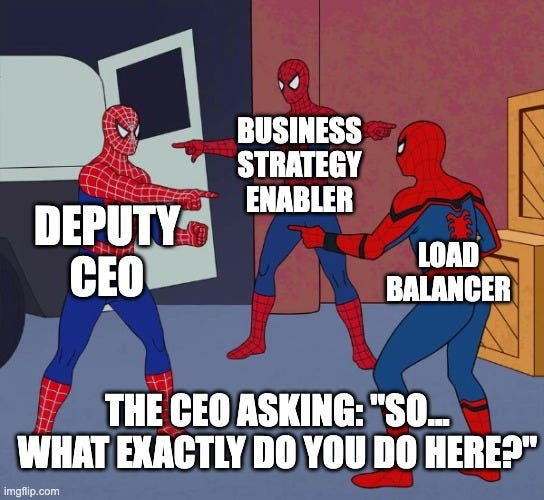
As most American product guru’s would say “CPO drives business strategy and innovation”.
Whatever the heck that means. Innovation is just a load of cheese.
Does CPO provide an angle to a strategy? Sure.
But does or should he drive one? I’m not so sure.
The business strategy is a determinant, a CPO is an enabler from the product side.
One who acts as a load balancer between teams with different goals, priorities and resources.
A hard question to ask - does a company really need a CPO?
0-1, early stage – definitely not.
Mid-sized scale-up – it depends on how operational your business is.
A large 500+ person organization with a digital product at the heart of it – absolutely yes.
In contrast to all the polished advice you hear from product gurus on Lenny’s Podcast and the like – here are 10 real, hard-earned truths from surviving a CPO marathon.

1️⃣ “Hiring and firing” are your highest ROI activities
You should be sourcing people even before you start your job.
Hire like crazy.
Do not do anything else until you have your team set up.
If you try to act as a superhero and try to step into the IC role until you have your team, you’ll drown.
First, get the key people on board. They are your leverage. Your work only starts once you have the team fully equipped.
Get rid of people fast. If it doesn’t work out, it doesn’t. No hard feelings.
You’re doing this person a favor. If it’s a toxic bully, narcissist, or any other vibrant personality - the longer you delay the decision, the closer you are to getting fired as a CPO.
Nothing ruins the morale of the team like a single bully.
If you want to get to this “tribal leadership level four,” your bullies are the ones who’ll ensure you never will.
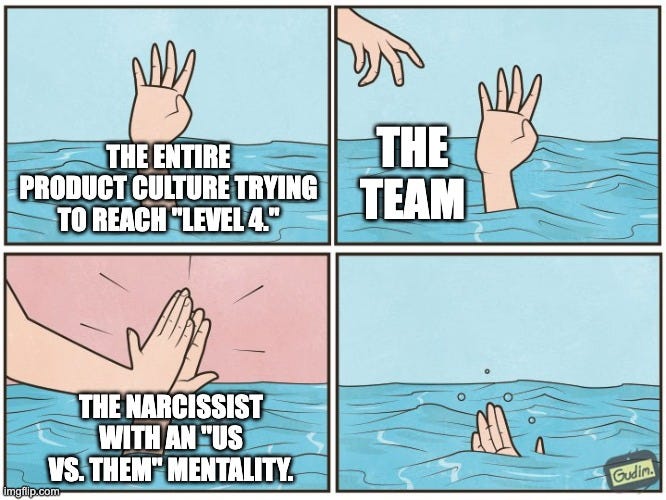
They will hold onto “us versus them” for their lives.
It’s what gives them validation they didn’t get enough of as kids. It’s their life motto.
You are there to ensure no toxic personalities feed off their ego by victimizing the team.
2️⃣ Process matters way less than people
You hire strong people to reduce the process load.
They can handle the uncertainty and complexity, and create structure where there is none.
An under-qualified manager will not. She will need handholding and processes, and will complain about how hard the work is.
The more junior your org is, the more processes you’ll need.
The more process tax you apply, the slower you are. The absolute manifestation of this is a complete stop. A single release will take months, and your company will be cooked.
My take is that you should balance out seniorities. A senior PM can effectively coach up to 2 junior/mid-level PMs. If you add more, then the senior guy would be a full-time mentor without any resources for execution.
When you’re just starting out, you don’t have the capacity for junior/mid-level managers. You need senior people who will push it forward.
3️⃣ You inherit a business strategy and enhance it, not create a competing one
You are there to drive an existing business strategy, not create a competing one.
Add a product angle to the discussions on the strategy and go on executing it.
Don’t waste time on creating your own “strategy” and working it out in a “strategic silo.”
You are there to enable the business in executing the strategy.
There are times when business doesn’t have a clue or product has an outsized leverage, yes.
That just means that your input as a leader would be greater.
It still doesn’t mean you need to develop a strategy in “a product team silo”.
4️⃣ Do not sleep until you define goals and metric trees
If you don’t have your entire business mapped out as a metric tree - you’ll burn.
The fact of the matter is, you don’t know if somebody’s doing a good or a bad job if you have no target or a benchmark.
Smart people will effectively cheat you into believing they are doing great.
Beautiful narratives on how one did an amazing job, has underslept, and sacrificed the time with his family for this work.
Nope.
Until you have an objective evaluation system - reality will always be manipulated.
Here are your inputs. Here are the results.
Results achieved - great, rinse and repeat, get more resources if needed.
Results failed - why?
If no answer, here’s the PIP.
Having a metric-based goal system (preferably binary and not ambiguous OKRs) removes so much friction from the system.
It becomes a fair game based on outcomes and not optics.
5️⃣ You are an enabler, not a visionary
A visionary CPO is the one who won’t get the job done.
There’s nothing to envision.
The business model in which you operate is already determined (in most cases).
The levers you need to pull are determined as well.
Vision exercises are just team buildings where people get together for entertainment.
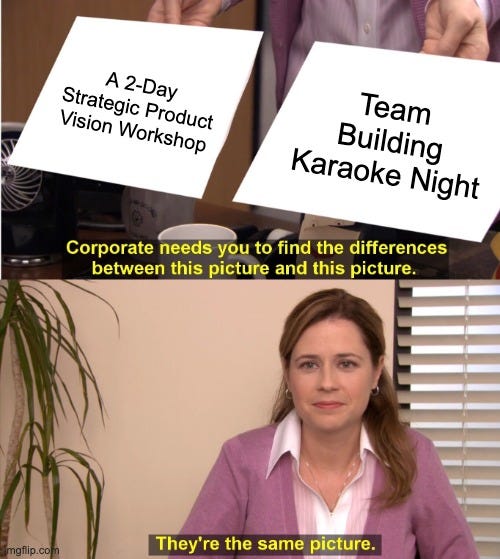
An enabler, on the other hand, is the one who streamlines the execution.
Sets goals, resource allocation, raises the bar, and removes the bottlenecks from the process.
It’s a factory, not a Disneyland.
6️⃣ Being a balancer is your main job
Two verticals, two business leaders, two different goals attributed to two different product teams.
A cross-functional project that requires both teams to collaborate.
Who will balance their interests? (Who you’re going to call?)

A business leader?
Nope, he doesn’t have details.
You’re going to add a CPO to ensure the teams are aligned and working collaboratively on competing goals.
If there’s no CPO, the issues will bubble up, overloading the business leaders first, then the CEO.
7️⃣ Time to market is one of your key metrics
The entire org is as good as how fast the time to market is.
If it takes you months to roll out a single UX update, no matter how strong your product team is - that’s a dead end.
The faster you ship, the more value can materialize.
The more value you get, the more revenue the business gets.
A simple flywheel.
Obsess about shortcutting your time to market.
Is it discovery that’s bottlenecking the entire team? Or delivery? Q&A? Release cycles? Drill deeply into it.
8️⃣ Impact is your currency
You gain credibility by shipping impact.
The higher the revenues, EBITDA or whatever metric you are aiming at - the more trustworthy you’ll be in the org.
Leadership (and particularly CEO) will overlook your managerial style or organizational gaps. You’ll be given more freedom and resource to build whatever sandbox environment you want your product team to be.
On the opposite side, if you show insufficient or no measurable impact - expect to lose influence.
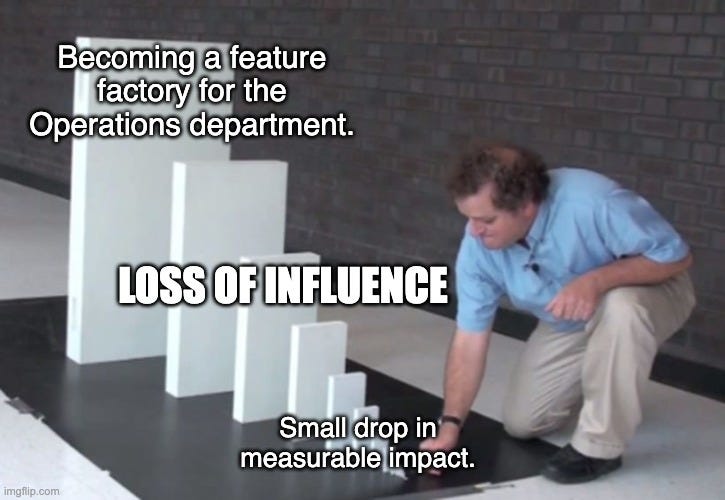
CEO needs impact so he empowers functions that can deliver it faster with better paybacks. If it’s marketing - the company will eventually become marketing-led. If it’s operations - well, you know where I’m getting to.
A lack of impact is a downward spiral for the CPO and the product team. The more influence lost, the more constrained and top-down project driven the function will become.
9️⃣ Rotate generalists, fix specialists
There are largely two types of PMs - generalists and specialists.
Generalists love value discovery and problem solving. They get bored quickly (1-2 years) and need a change of scenery to maintain motivation. Sometimes they do not realize it and you have to help them by making a soft push.
Specialists are domain specific PMs. Usually domain expertise is formed around a complex subsystem. Say - search technologies, LLMs, fintech, fraud e.t.c. Specialists thrive on deepening their domain expertise. If you shift them around, they will lose ROI and motivation.
A good rule of thumb is to keep generalists in regular rotation and help specialists to stick to their existing domains.
🔟 Build support systems
You cannot do it by yourself. Your direct reports cannot do it by themselves.
The only way it can work out is if there are support systems in place.
Engineering, design or analytics can step in and support product by overtaking chunks of product decisions or even projects.
Same goes in the other direction.
If an engineering team is delaying a start of the project, because they need to get a polished PRD from the PM first - well, something has gone terribly wrong already.
There’s no support. It’s a world of transactional relationships between teams and those are terribly slow (read as longer time to market).
There should be no rigid “job descriptions”.
“What’s my job description?” is a junior-level question.
You are there to operate in a context of high ambiguity where you have to pave it out for yourself.
There should be no strict boundaries between roles as well.
In this way, the support systems can emerge as well as heightened sense of ownership.
In a “what’s my job description” world you would hear - “that’s not my domain” OR “that’s not my responsibility” OR “I don’t know whose responsibility that is”.
You have a metric you need to move, own it end-to-end. Even if it requires stepping outside of your domain.
It's a dope
🔥🔥🔥