
The Truth Behind Lay-offs
AI efficiency is just a cover-up story. Here's the real reason why tech giants are on a layoff spree.

Lay-offs are the hottest topic right now, getting the highest amount of media attention after AI agents.
Every week or so a new round is announced by large companies.
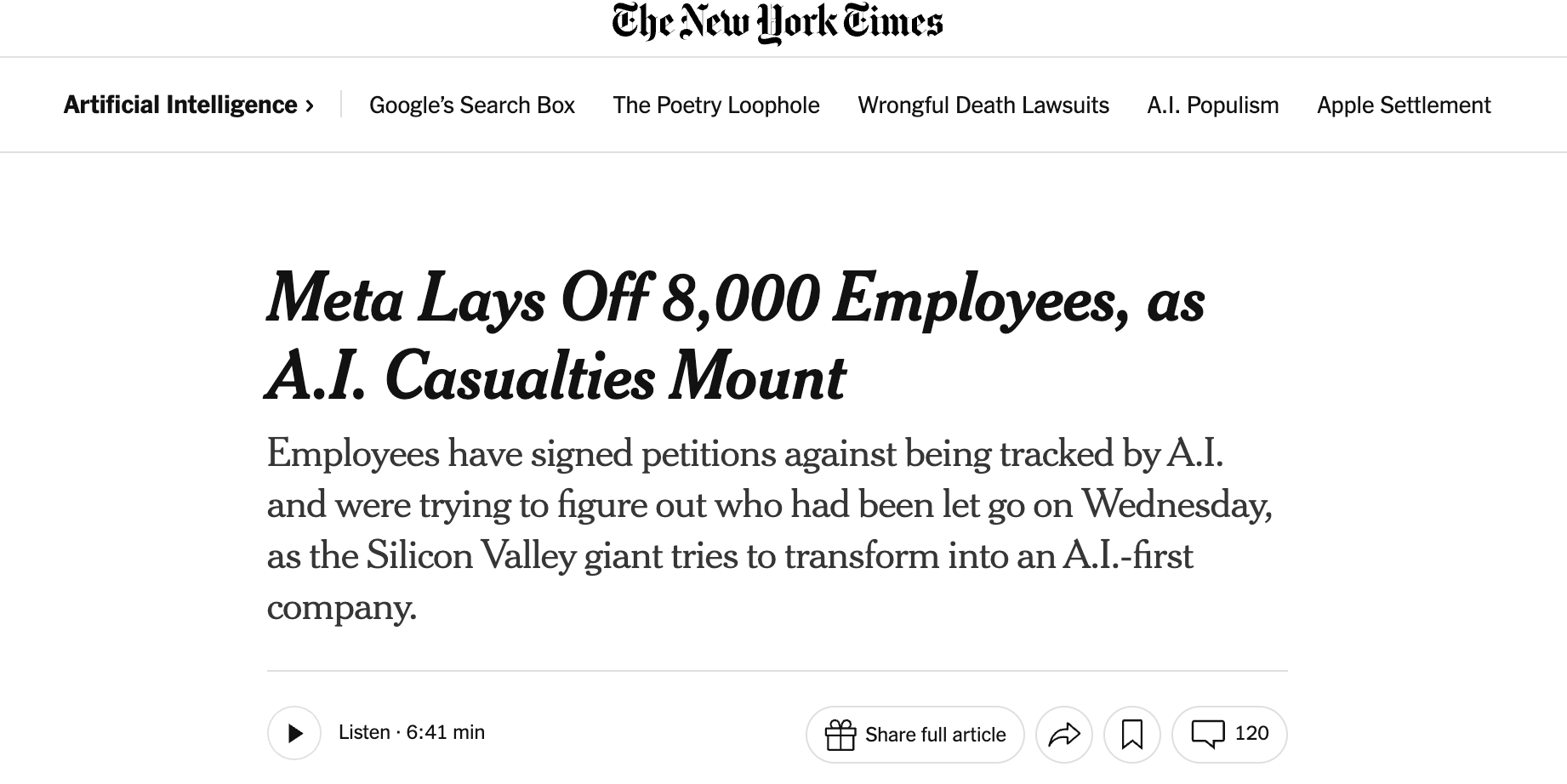
Just recently (20th of May) Meta announced a 10% cut of their entire workforce or a whopping 8k employees. This sums up to ~35.7k total people laid off just from Meta alone over the course of the last 3 years. More importantly, they do not rule out future rounds of lay-offs.
And the same story plays out across the entire Big Tech.
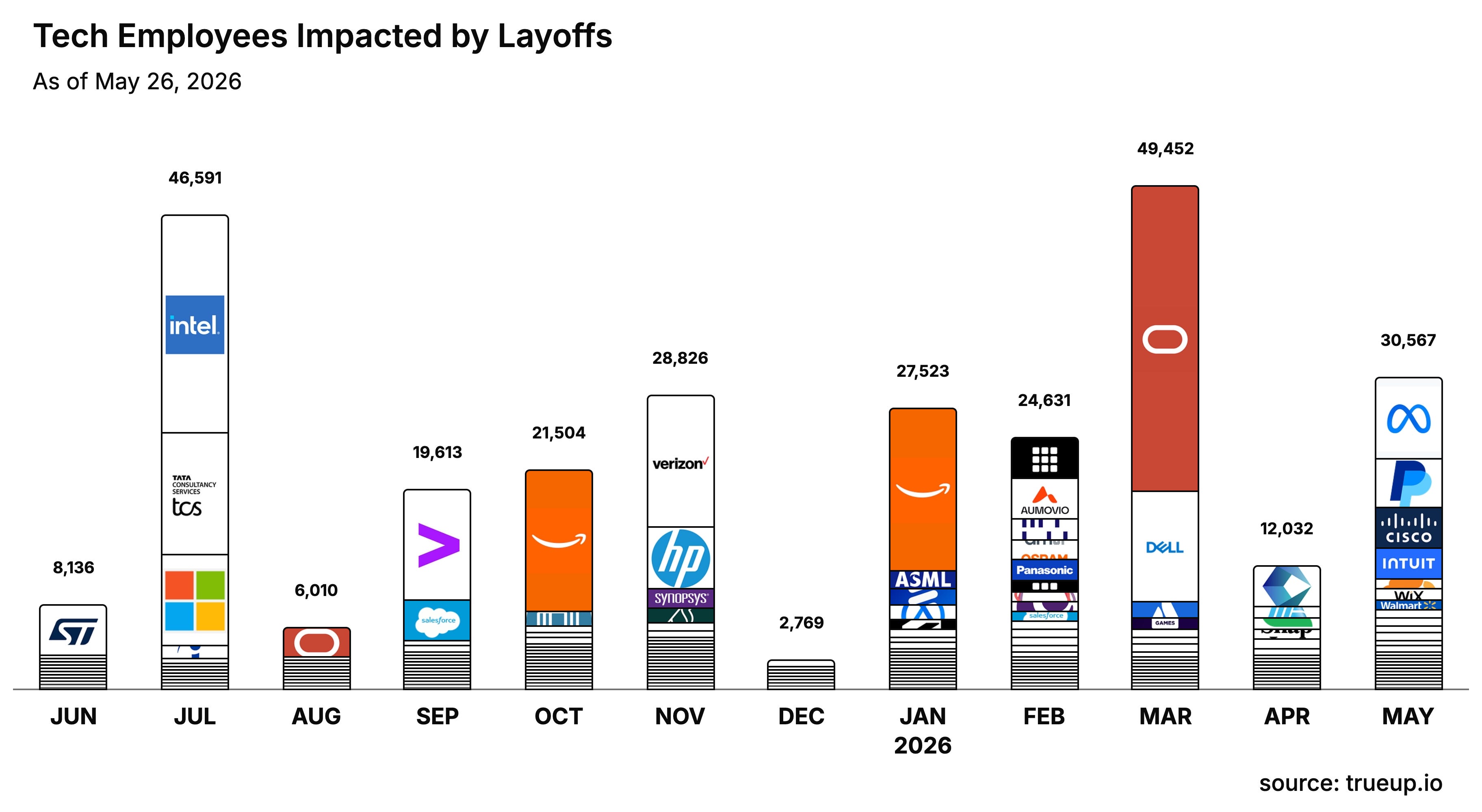
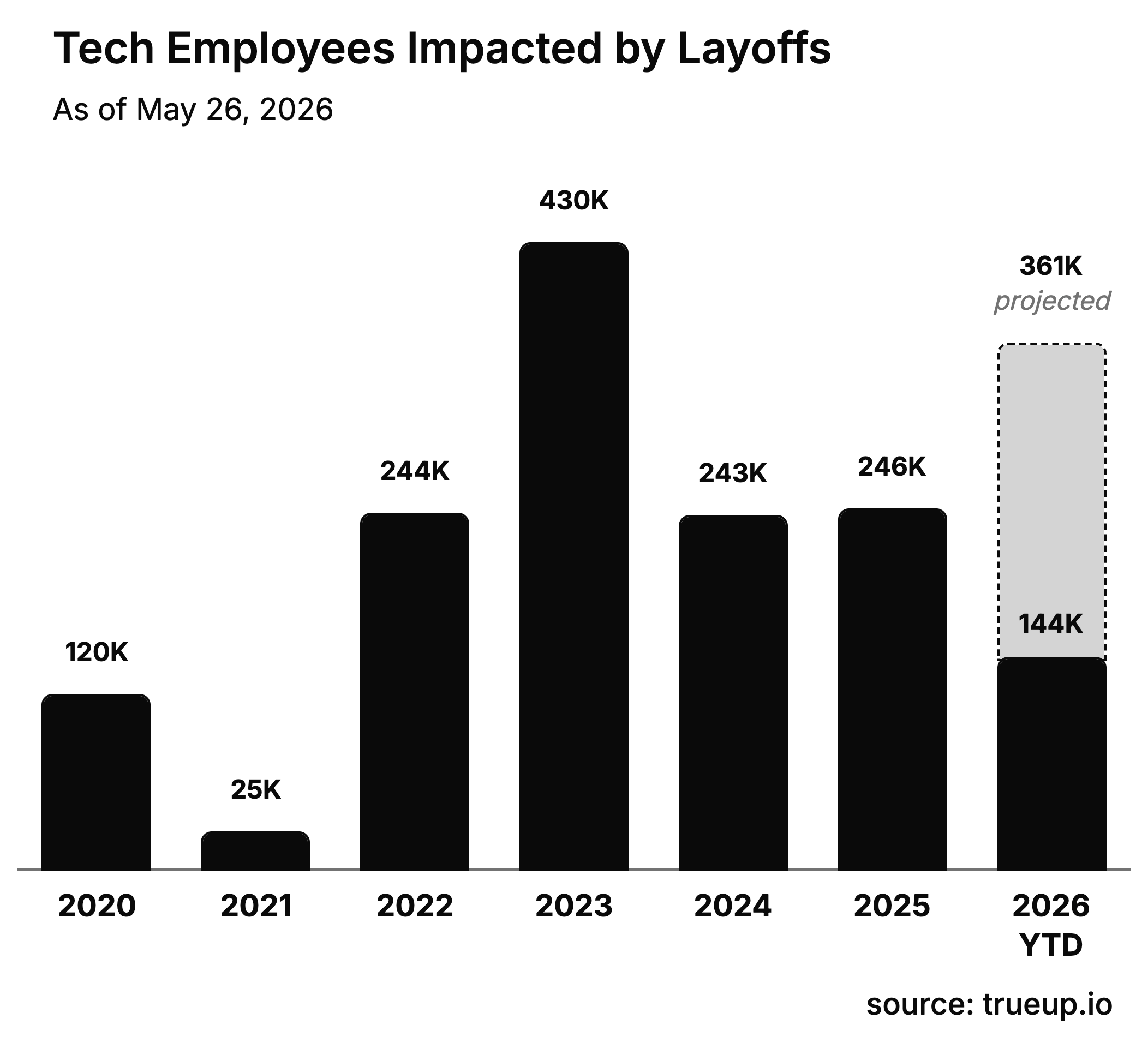
In 2026 alone Oracle has laid off 30k employees, Amazon 16k, Dell 11k, Block 4k and the total amount of people let go amounts to 144k. Some analysts even project this number would go as high as 361k.
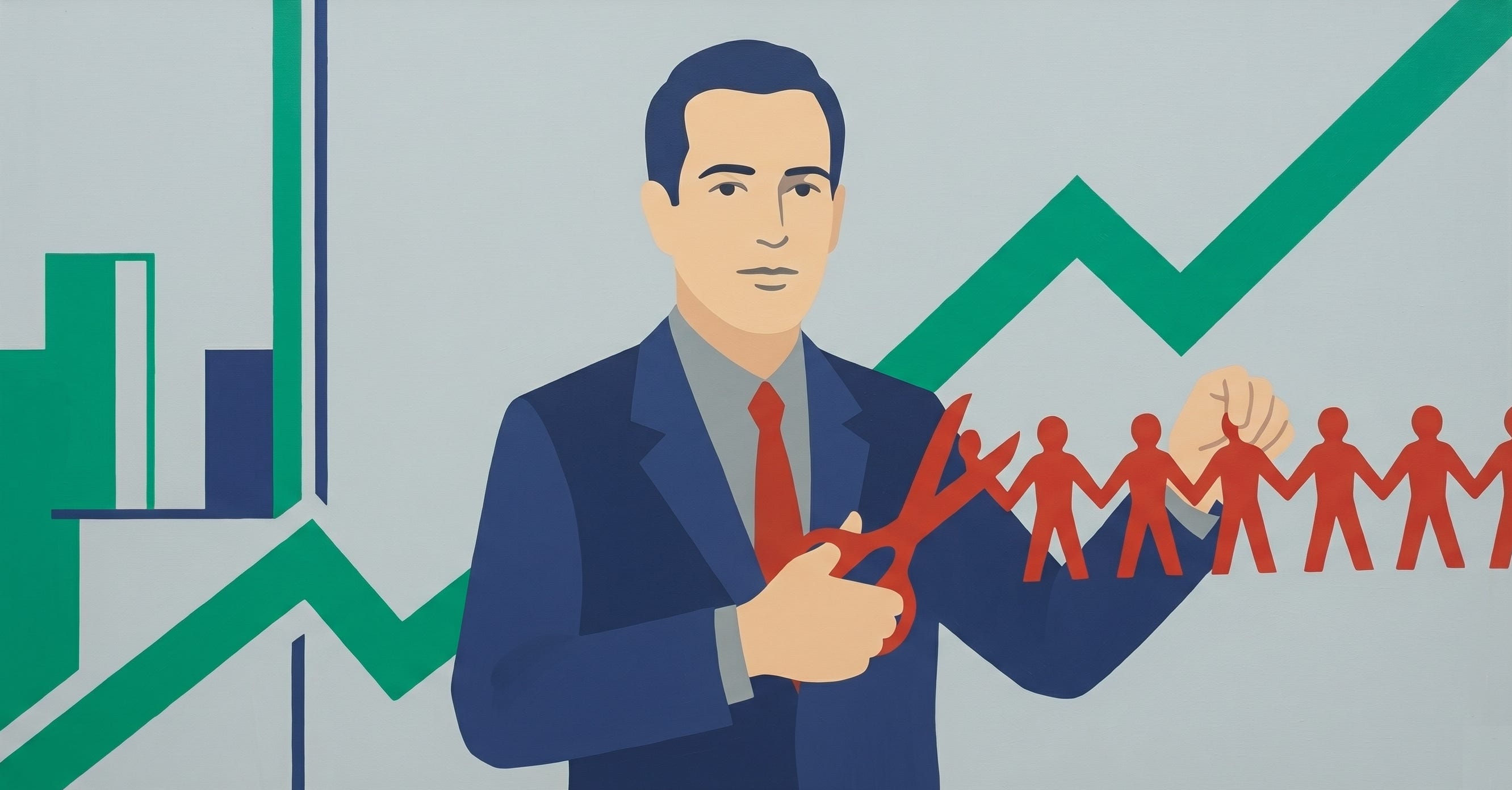
While BigTech wants you to believe this is AI efficiency related (this is the most widely circulated narrative), the truth lies elsewhere.
In fact lay-offs are one of the most effective playbooks at stock price manipulation.
Here’s why.
📉 Layoffs vs. The Stock Price
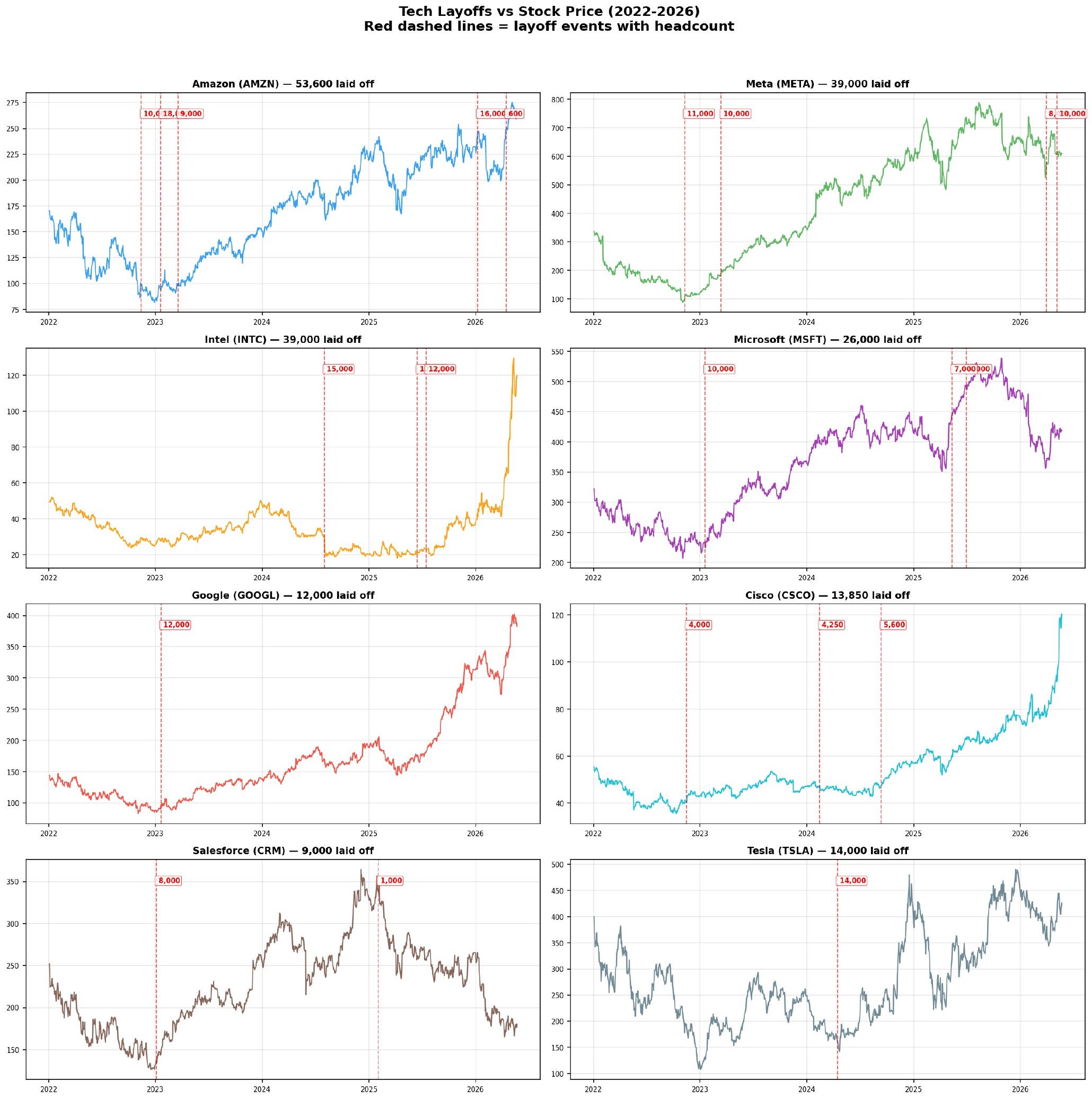
Look at those charts. Every red line sits right before a green candle.
Meta, November 2022. Stock at $90. Zuckerberg announces 11,000 people are gone. Four months later: $180. By year end: $350. The stock recovered.
Google, January 2023. Pichai cuts 12,000. Stock jumps 5% the same week. Amazon does 18,000 the same month. Same reaction. Microsoft trims 10,000. You know the drill.
The pattern holds across four years and five companies. Not a single one of these announcements produced a sustained stock decline.
If this were about genuine efficiency, you’d expect variation - some companies executing well on AI, others not so great. Instead the market rewards the same thing every time: fewer people on payroll.
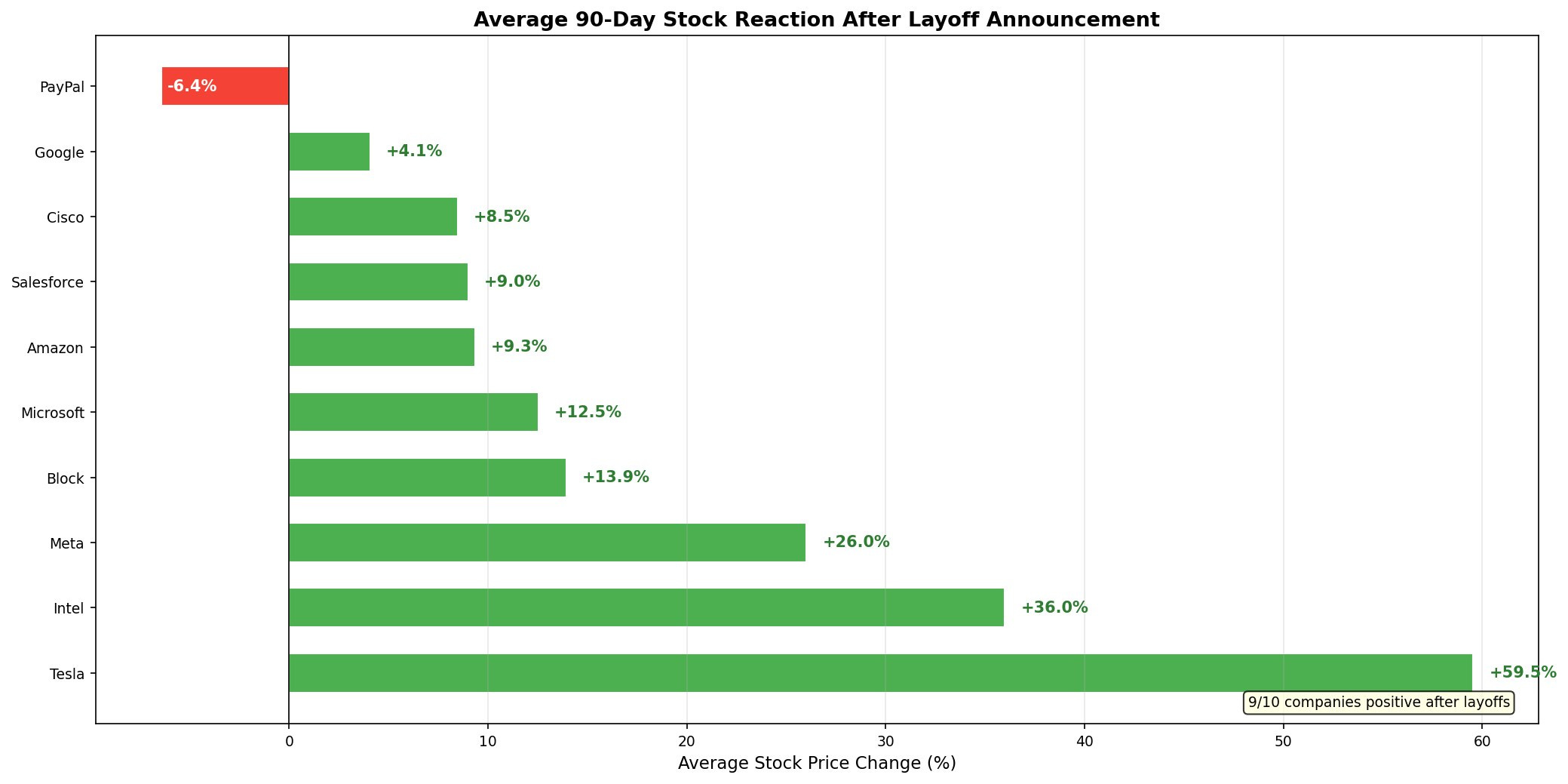
The average 90-day return after a major layoff announcement across Big Tech between 2022 and 2026 is positive. Consistently.
This chart aggregates every layoff event from Meta, Google, Amazon, Microsoft, and Apple over four years. It tracks what the stock did in the following three months.
The market has turned layoffs into a buy signal. Fund managers see the headline, check the size of the cut, place the trade. The logic is mechanical: fewer employees means lower opex, which means margins expand, which means earnings beat estimates next quarter.
If you’re a CEO with 70% of your compensation in stock, and you know the market will reward you for cutting heads, what do you think happens next?
You cut heads.
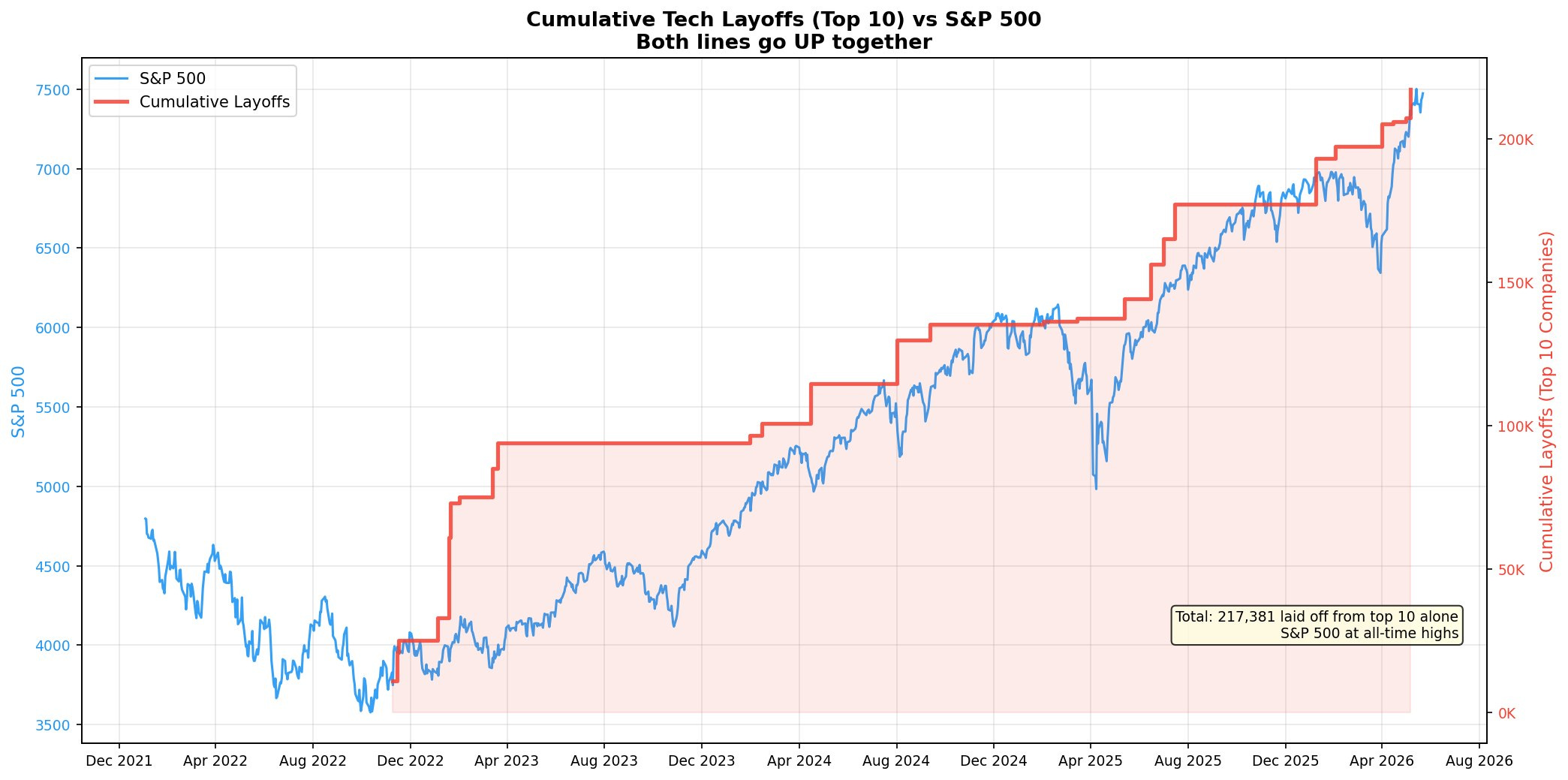
The same pattern shows up at index level. Quarters with the highest volume of layoff announcements across the tech sector correspond with the S&P 500’s strongest rallies.
The mechanism is straightforward. Tech is 30%+ of the S&P 500 by weight. When all the big names simultaneously “optimize” their cost structures, the whole index rises. Coordinated upward pressure on the market that makes everyone with a 401(k) feel richer.
Which makes it politically untouchable.
🔄 Are layoffs just a correction?
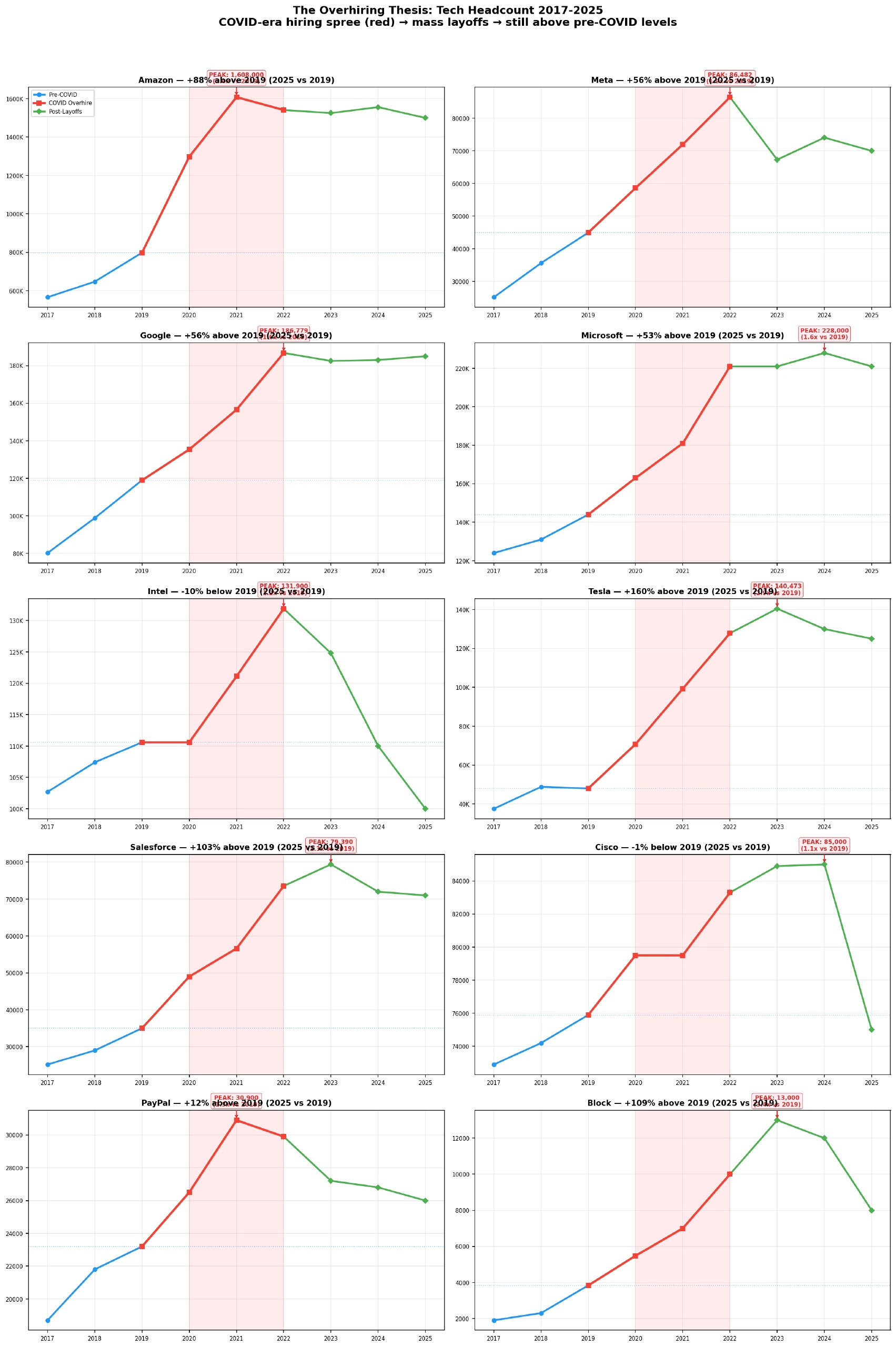
The other narrative: “They over-hired during COVID. This is just a return to normal.”
There’s some truth in it. Between 2020 and 2022, Big Tech added headcount like they were outrunning extinction. Meta went from 48,000 to 87,000 employees. Google from 135,000 to 190,000. Amazon’s corporate headcount ballooned by over 100,000.
Zero-interest rates made hiring free. Product usage was spiking because everyone was stuck at home. So they hired.
Then rates went up. Growth decelerated. All those people looked expensive.
Fine. That explains the 2022-2023 cuts.
But the layoffs didn’t stop once the pandemic excess was trimmed. Google has done five separate rounds since January 2023. Meta cut new headcount continuously despite being more profitable than at any point during the hiring spree.
If this were a correction, it would have ended two years ago. Companies aren’t returning to normal. They’re cutting into muscle because the market keeps rewarding it.
🎩 The EPS magic trick
Here’s the financial engineering behind the curtain.
Earnings Per Share is the single most-watched number on Wall Street. Every quarterly earnings call, it’s the first thing analysts look at. Did EPS beat estimates?
EPS has two components:
Earnings on top (profit).
Shares outstanding on the bottom.
You can increase it two ways. Grow profits, or have fewer shares.
Layoffs do the first one mechanically. Cut 10,000 people at an average fully-loaded cost of $200,000 each and you just added $2 billion to your annual bottom line. Nobody shipped anything new. You stopped paying people.
The big names don’t stop there. They combine layoffs with share buybacks.
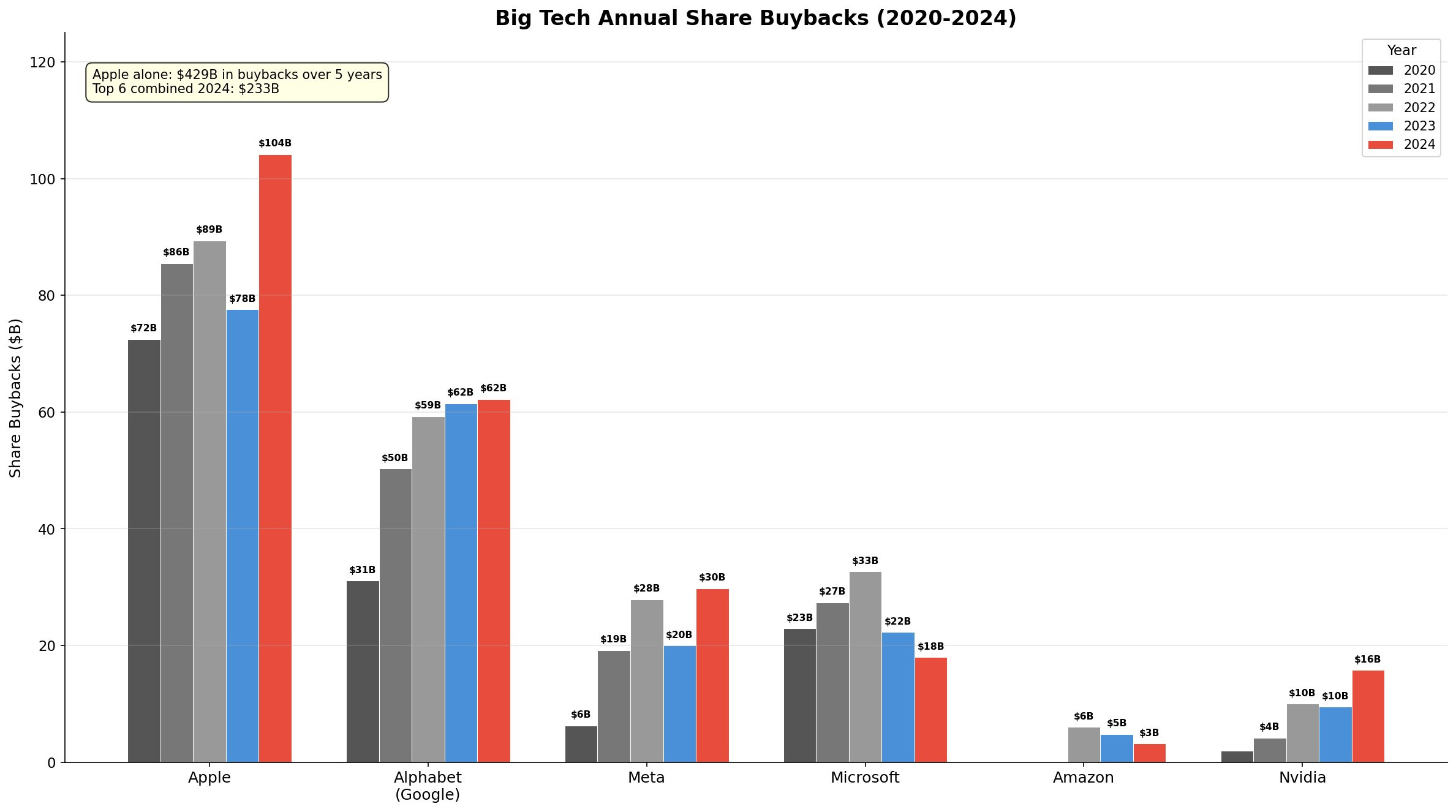
Meta spent $28 billion buying back its own stock in 2024. Apple spent $90 billion. Google $62 billion. Take the money you saved on payroll, buy back shares, and now EPS goes up from both ends. The denominator shrinks. The numerator grows.
A simple example. Company earns $10b, has 1B shares. EPS is $10.
Now you cut 10% of costs (immediately +$1b profit) and buy back 15% of the shares.
New EPS = $11B / 850m = $12.94 or a 29.4% EPS jump.
Wall Street calls this “returning value to shareholders”. Workers call it getting fired so the stock price ticks up three points.
💰 Follow the money
If layoffs reliably boost EPS and stock price, it’s worth looking at who benefits most from higher stock prices.
Sundar Pichai’s 2022 compensation was $226 million, almost entirely in stock awards. Tim Cook, Satya Nadella, Andy Jassy, Zuckerberg - same structure across the board. At this level, executive pay IS stock price performance.
When the stock rises 15% after a layoff round, those packages appreciate by tens of millions of dollars. The board sets compensation targets tied to stock performance.
Layoffs push the stock up. Targets get hit. Equity vests.
None of this requires bad intentions. The system is built so that the people making headcount decisions are the same people whose wealth is most directly tied to the stock price reaction.
That’s the incentive structure doing what incentive structures do.
📜 We’ve seen this before
This pattern has deep roots. In the 1990s the playbook was called “downsizing”. Then “right-sizing”. Then “restructuring.” In 2026 it’s “AI-driven efficiency”.
The vocabulary changes. The underlying mechanics are remarkably consistent.
Jack Welch built GE’s reputation partly on annual workforce culling - remove the bottom 10% every year. Stock went from $12 to $600 between 1981 and 2000. It worked consistently well.
IBM’s Lou Gerstner cut 60,000 people between 1993 and 1995. Stock tripled. The cuts were part of a genuine strategic pivot from hardware to services, and Gerstner deserves credit for that. But the cost-cutting muscle memory outlasted the strategy. IBM’s revenue declined nearly every year for a decade afterward as successive leaders kept trimming the headcount.
The risk is always the same. Cost cuts deliver fast, visible results. Building takes longer and isn’t guaranteed. Organizations that learn to rely on the first one can lose the ability to do the second.
The new ingredient in 2026 is that “AI” is a more compelling justification than “synergies” was in 2005. It sounds forward-looking. Makes for a better earnings call. But the financial mechanics underneath haven’t changed.
🎯 TL;DR
The official narrative: “We’re using AI to do more with fewer people”.
What the data shows: layoffs reliably boost stock prices within 90 days across every major tech company. The pattern has held for four years straight.
The mechanics: fewer employees means lower costs, higher EPS. Combine with stock buybacks and EPS rises from both directions at once.
Worth noting: executive compensation at these companies is 70-90% stock. The people making headcount decisions benefit most directly from the stock price reaction those decisions produce.
The stated reason: “post-COVID correction”. But the correction window kind of closed two years ago. The layoffs accelerated anyway.
Draw your own conclusions.
Finally someone explained this with solid arguments, thank you for the article!
totally agree with you here. it’s been interesting to watch them use it as a cover story.. great read.